How Weather Forecasts Are Made: Understanding the Process and Technology Behind Predictions
Weather forecasts play a crucial role in everyday life, helping individuals plan their activities by providing timely information about atmospheric conditions. These forecasts are made by analysing data from satellites, weather stations, and computer models that simulate the atmosphere’s behaviour. By interpreting these vast amounts of information, meteorologists can predict various weather phenomena with increasing accuracy.
The science of meteorology encompasses several techniques to gather and analyse data. Advanced technology, such as Doppler radar and satellite imagery, allows meteorologists to monitor real-time conditions and changes in the atmosphere. This wealth of data is then processed through sophisticated algorithms and models, leading to the creation of reliable forecasts.
Understanding how weather forecasts are made unveils the dedication and expertise required in meteorology. As readers explore further, they will gain insights into the technologies and methods that shape daily weather predictions, enhancing their appreciation for the forecasts that inform their everyday decisions.
The Science of Meteorology
Meteorology combines the principles of physics and chemistry to understand weather patterns and phenomena. It involves the study of the atmosphere’s behaviour and how various elements interact to influence weather.
Atmospheric Fundamentals
The atmosphere is composed of layers, each with distinct characteristics. The troposphere, where weather occurs, contains water vapour, gases, and particles. Key elements include temperature, pressure, and humidity, which interact to shape climate and weather.
- Temperature influences air density and pressure.
- Pressure gradients drive wind patterns, which can lead to changes in weather.
- Humidity affects cloud formation and precipitation.
Meteorologists measure these factors using instruments such as barometers for pressure, thermometers for temperature, and hygrometers for humidity. Understanding these fundamentals is crucial for accurate weather forecasts.
Meteorological Phenomena
Weather phenomena range from clear skies to severe storms. Common events include precipitation, thunderstorms, and snow. Each type has specific meteorological conditions.
- Precipitation occurs when water vapour in the atmosphere condenses into droplets or ice crystals.
- Thunderstorms develop from warm, moist air rising rapidly, leading to strong updrafts and downdrafts.
- Snow forms when the atmospheric temperature is low enough for ice crystals to coalesce.
These phenomena are influenced by atmospheric dynamics and can vary significantly across regions. Meteorologists study patterns to predict weather events effectively, improving forecasting accuracy for daily use.
Data Collection Techniques
To create accurate weather forecasts, meteorologists rely on various data collection techniques. These methods involve utilising ground-based observations and employing remote sensing equipment to gather essential weather data.
Ground-based Observations
Ground-based observations are fundamental for weather forecasting. Meteorologists use weather stations equipped with instruments to measure temperature, humidity, wind speed, and precipitation levels. These stations provide real-time data, which is vital for analysing local weather patterns. Many stations also utilize isobars to depict pressure differences, helping in understanding wind movements.
Additionally, weather balloons are launched from specific sites. These balloons ascend into the atmosphere, collecting data on temperature, humidity, and winds at different altitudes. This data is crucial for models predicting weather systems and changes.
Remote Sensing Equipment
Remote sensing equipment offers a broader view of weather conditions from above the Earth’s surface. Satellites play a pivotal role in this area, capturing images and data across large regions. They provide information on cloud cover, sea surface temperatures, and atmospheric conditions, which are essential for understanding global weather patterns. Satellites also aid in tracking storms and severe weather events.
Radar systems complement this data by providing detailed images of precipitation and storm structure. They help meteorologists measure rainfall intensity and track shifting weather systems in real time, allowing for timely warnings and updates.
Numerical Weather Prediction (NWP)
Numerical Weather Prediction (NWP) encompasses complex computer models that simulate atmospheric conditions to produce weather forecasts. These models rely on mathematical equations to represent the behaviour of the atmosphere, factoring in initial conditions to predict future weather patterns.
Evolution of Weather Forecast Models
The journey of weather forecasting began with simple observational techniques. Early methods relied solely on meteorological observations, but the introduction of NWP transformed this landscape significantly.
In the 1950s, the early numerical models were developed, utilising primitive computing technology. These models required significant time and resources, but advances in computing power led to more sophisticated forecasting capabilities.
Modern NWP utilizations employ ensemble forecasting, which generates multiple weather outcomes based on varying initial conditions. This approach enhances accuracy by providing wind speed, pressure, and temperature variations within the predictions.
Computing Methodologies
NWP leverages powerful supercomputers to process vast amounts of data quickly. These computers run complex numerical models that implement advanced mathematical equations to forecast specific weather conditions. Spatial resolution is a critical factor as it determines the detail level in weather models. Higher resolution models can depict localized phenomena, but they require more computational resources.
Ultimately, combining increased computing capabilities with refined models allows forecasters to produce timely and accurate weather forecasts. The synergy of these elements leads to improved decision-making for industries reliant on weather predictions.
Interpreting and Disseminating Forecasts
Weather forecasts require precise interpretation and effective dissemination to ensure accurate communication of expected conditions. Human judgment plays a crucial role, as does the choice of distribution channels utilised to relay this information to the public.
Role of Human Forecasters
Human forecasters bridge the gap between raw data from weather models and public understanding. They analyse weather maps and data generated by mathematical models, which simulate atmospheric conditions.
Forecasters assess this information using their expertise, focusing on elements like temperature, precipitation, and wind patterns. They identify potential extreme weather events and adjust forecasts based on local anomalies that models may overlook.
Additionally, forecasters communicate uncertainty levels associated with predictions. For example:
- High confidence: Well-agreed predictions.
- Medium confidence: Possible variations.
- Low confidence: Significant uncertainty.
This nuanced understanding helps the public better prepare for prevailing weather conditions.
Distribution Channels
How weather forecasts are disseminated greatly influences their effectiveness. Various channels are employed to reach different demographics, including:
- Television and radio: Deliver forecasts to a broad audience.
- Mobile apps: Provide personalised local weather updates.
- Social media: Facilitate real-time alerts and engagement.
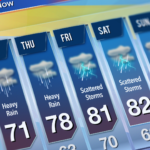
Weather agencies often prioritise clear and consistent messaging across these platforms. They utilise graphics, such as weather maps, to visually represent forecast data, making it more accessible. Increasingly, tailored information is distributed to sectors like agriculture or emergency services. This targeted communication ensures that those who need specific weather details receive timely and relevant forecasts.